

Introduction: A Global Shift in Aluminium Extrusion Sourcing
By 2026, the global aluminium extrusion industry is undergoing a major structural shift. Buyers who once relied heavily on a few traditional manufacturing regions are now actively diversifying their supply chains.
At the center of this shift is India, rapidly emerging as a global aluminium extrusion hub, particularly for:
- Large and wide aluminium profiles
- Complex hollow and multi-cavity sections
- High-precision industrial and structural applications
This transformation is not accidental. It is the result of sustained investment in technology, scale, engineering talent, and process maturity.
This blog explains:
- Why global demand for large and complex aluminium profiles is rising
- What capabilities are required to manufacture such profiles
- Why India is uniquely positioned to meet this demand
- What global buyers should look for in Indian extrusion partners
Rising Global Demand for Large and Complex Aluminium Profiles
Infrastructure and Industrial Scale Are Increasing
Modern projects are larger, heavier, and more integrated than ever before. Across sectors, aluminium profiles are now required to:
- Span longer distances
- Carry higher loads
- Integrate multiple functions into a single extrusion
This is evident in:
- Infrastructure megaprojects
- Renewable energy installations
- Transportation systems
- Industrial machinery and automation lines
As a result, demand for wide, thick-wall, and complex aluminium extrusions is accelerating globally.
Design Complexity Is Replacing Simple Sections
Earlier aluminium extrusions focused on basic shapes. By 2026, engineers demand:
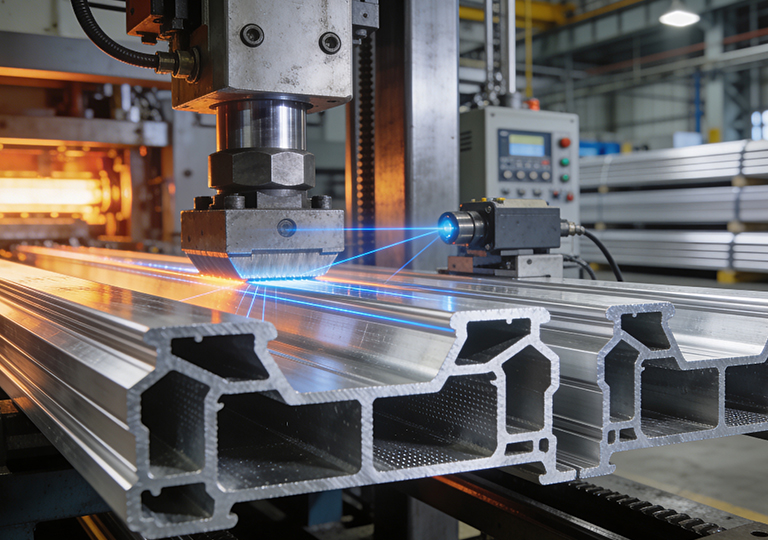
- Multi-chamber hollow profiles
- Integrated fastening and drainage features
- Precision tolerance across large cross-sections
Complexity reduces:
- Assembly steps
- Fasteners and joints
- Installation time
This places higher demands on extrusion technology and die engineering.
What It Takes to Manufacture Large and Complex Aluminium Profiles
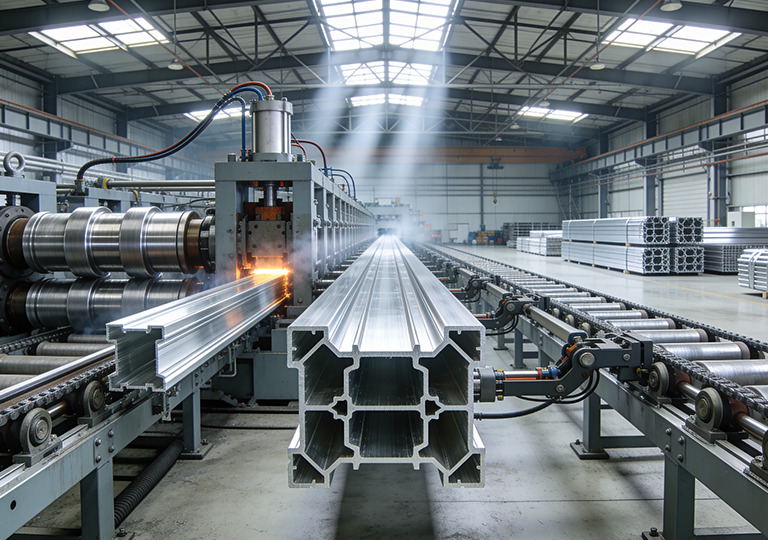
High-Capacity Extrusion Presses
Producing large aluminium profiles requires:
- High-tonnage extrusion presses
- Stable press alignment
- Advanced billet heating and handling systems
Without sufficient press capacity, manufacturers face:
- Dimensional instability
- Surface defects
- Inconsistent mechanical properties
India’s investment in high-capacity extrusion infrastructure has been a critical enabler.
Advanced Die Engineering and Tooling Control
Complex profiles place immense stress on extrusion dies.
Manufacturers must master:
- Flow balancing across wide sections
- Bearing length optimization
- Controlled metal flow in hollow profiles
In-house die manufacturing and correction capabilities are essential for:
- Dimensional accuracy
- Repeatability across long production runs
- Reduced trial and error
Billet Quality and Metallurgical Consistency
Large profiles amplify billet-related issues.
Uniform billet quality ensures:
- Stable extrusion speed
- Consistent grain structure
- Superior surface finish
Advanced billet casting and homogenization processes are mandatory for large-section extrusion success.
Why India Is Succeeding Where Others Are Struggling
Strategic Investment in Scale and Technology
Indian aluminium manufacturers have made long-term investments in:
- Large extrusion presses
- Multiple parallel extrusion lines
- Integrated billet casting and die shops
This allows:
- High-volume production
- Simultaneous project execution
- Reduced dependency on external suppliers
Scale is now a competitive advantage, not a bottleneck.
Engineering Talent and Process Discipline
India’s strong base of:
- Mechanical engineers
- Metallurgists
- Tooling specialists
has accelerated learning curves in complex extrusion.
Combined with improved process documentation and quality systems, this has elevated India’s manufacturing credibility.
Cost Efficiency Without Compromising Quality
India offers a rare balance:
- Competitive production costs
- Increasingly global-quality output
This makes Indian aluminium extrusions attractive for:
- Infrastructure developers
- Renewable energy companies
- OEMs seeking cost-effective scalability
Global Buyers Are Re-Evaluating India as a Preferred Sourcing Destination
Supply Chain Diversification
Post-pandemic and geopolitical disruptions have forced buyers to:
- Reduce single-region dependency
- Build resilient, diversified supply chains
India has emerged as a stable, scalable alternative.
Export-Ready Manufacturing Ecosystem
Indian aluminium manufacturers now routinely meet:
- International quality standards
- Export documentation requirements
- Custom compliance frameworks
This has increased India’s participation in global aluminium projects.
Applications Driving India’s Extrusion Growth
Infrastructure and Construction
Large aluminium extrusions are used in:
- Structural frameworks
- Curtain wall systems
- Bridges and walkways
- Industrial buildings
India’s ability to produce wide and long profiles has expanded its role in global infrastructure supply.
Renewable Energy
Solar and wind installations demand:
- Lightweight yet strong structures
- Corrosion resistance
- Long lifecycle performance
Indian aluminium extrusions now support large-scale renewable energy deployments worldwide.
Transportation and Heavy Engineering
From railways to industrial machinery, complex aluminium profiles enable:
- Weight reduction
- Modular design
- Improved system efficiency
India’s extrusion capabilities are increasingly aligned with these needs.
Quality Expectations for Large Aluminium Profiles in 2026
Global buyers sourcing large profiles expect:
- Tight dimensional tolerances across wide sections
- Consistent surface finish
- Predictable mechanical performance
- Reliable batch-to-batch repeatability
Meeting these expectations requires:
- Process maturity
- Skilled quality control teams
- Investment in testing and inspection
Indian manufacturers are rapidly strengthening these systems.
How Surat Aluminium Aligns with This Global Shift
Surat Aluminium reflects India’s emergence as a global aluminium extrusion hub by focusing on:
- Advanced extrusion press capability
- Precision die manufacturing
- Consistent billet quality control
- Application-driven profile development
This enables the production of:
- Large and complex aluminium profiles
- Profiles tailored for infrastructure, energy, and industrial use
- Reliable solutions for both domestic and export markets
The emphasis is on engineering-first manufacturing, not commodity output.
What Global Buyers Should Evaluate When Choosing Indian Extrusion Partners
Before finalizing a supplier, buyers should assess:
- Maximum profile size and press capacity
- In-house die manufacturing and correction capability
- Billet sourcing and alloy consistency
- Quality assurance systems
- Track record in large and complex projects
The right partner reduces project risk and improves long-term performance.
Conclusion: India’s Role in Aluminium Extrusion Is Now Global
India is no longer an emerging player in aluminium extrusion.
It is becoming a global manufacturing hub for large and complex aluminium profiles.
Through:
- Technology investment
- Scale expansion
- Engineering excellence
- Sustainability alignment
Indian manufacturers are redefining global sourcing strategies.
For buyers seeking reliability, scalability, and long-term value, India has become a strategic aluminium extrusion destination.