

Introduction: One Metal Powering Three Global Revolutions
As the world enters 2026, three sectors dominate global investment and policy priorities:
- Infrastructure development
- Mobility transformation
- Clean and renewable energy
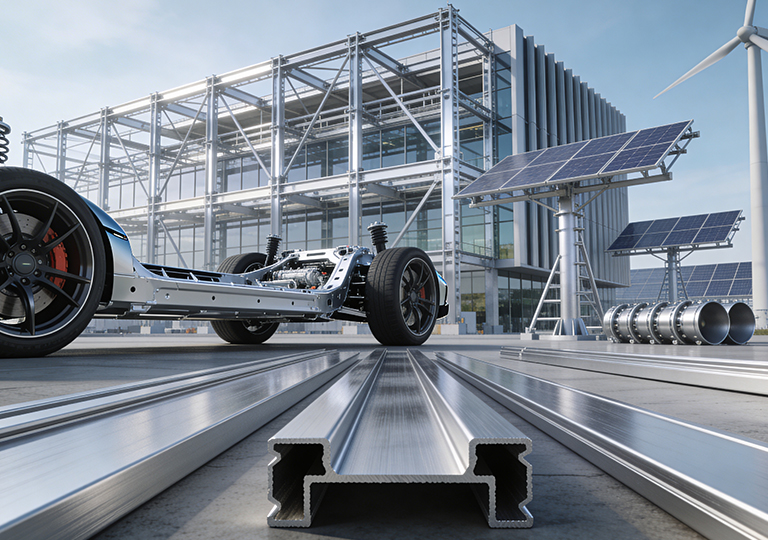
Across all three, one material consistently sits at the center of engineering decisions: aluminium.
Far from being just a lightweight alternative to steel, aluminium has evolved into a strategic engineering material that enables scale, speed, sustainability, and long-term performance. Governments, EPC contractors, OEMs, and industrial buyers increasingly select aluminium not only for its physical properties, but for its lifecycle value and future readiness.
This blog explores why aluminium continues to outperform competing materials in 2026, with a sector-by-sector breakdown covering:
- Infrastructure and construction
- Transportation and mobility
- Renewable and clean energy systems
It also explains what buyers should look for when sourcing aluminium extrusion partners in a high-performance, regulation-driven global market.
Aluminium in Infrastructure: Building Faster, Lighter, and Smarter
The Infrastructure Boom of 2026
Global infrastructure spending continues to rise sharply in 2026 due to:
- Urban population growth
- Smart city initiatives
- Transportation corridors and logistics hubs
- Industrial and commercial construction
Modern infrastructure demands materials that are durable, adaptable, and fast to deploy. Aluminium meets all three requirements.
Why Aluminium Is Ideal for Modern Infrastructure
1. High Strength-to-Weight Ratio
Aluminium provides excellent structural strength while remaining significantly lighter than steel. This allows:
- Easier transportation of profiles
- Faster on-site installation
- Reduced foundation load
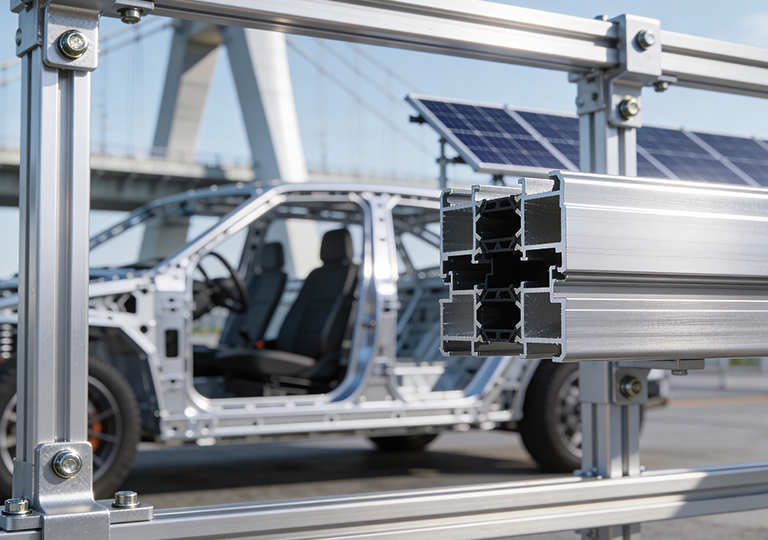
Large aluminium extrusions are now widely used in:
- Structural frameworks
- Curtain wall systems
- Bridges and walkways
- Industrial sheds and warehouses
2. Corrosion Resistance for Long Service Life
Infrastructure projects are designed for decades of use. Aluminium’s natural oxide layer:
- Protects against corrosion
- Performs well in coastal, humid, and polluted environments
- Reduces maintenance and repainting costs
This makes aluminium ideal for:
- Metro stations
- Airports
- Coastal infrastructure
- Industrial zones
3. Design Flexibility and Custom Profiles
Aluminium extrusion allows engineers to:
- Integrate multiple functions into a single profile
- Reduce fasteners and joints
- Improve structural efficiency
Custom extrusions enable innovative designs while maintaining strength and consistency.
Aluminium in Mobility: Driving Lightweight and Energy Efficiency
Mobility in 2026: A Lightweight Imperative
The global mobility sector is undergoing a fundamental shift:
- Electric vehicles (EVs) replacing ICE vehicles
- Lightweight rail and metro systems
- Fuel efficiency regulations tightening worldwide
Weight reduction directly improves:
- Energy efficiency
- Range and performance
- Emissions compliance
Aluminium plays a critical role in this transformation.
Aluminium Applications in Mobility
Automotive and Electric Vehicles
In EVs, aluminium is used extensively in:
- Battery enclosures
- Chassis and subframes
- Crash management systems
- Thermal management components
Lower vehicle weight means:
- Longer driving range
- Reduced battery size requirement
- Improved safety performance
Railways and Mass Transit
Aluminium extrusions are widely used in:
- Rail coach bodies
- Door frames and flooring systems
- Interior structural components
Benefits include:
- Reduced axle load
- Higher passenger capacity
- Lower energy consumption
Commercial and Industrial Transport
From logistics vehicles to heavy-duty transport systems, aluminium enables:
- Payload optimization
- Longer vehicle lifespan
- Reduced operating costs
Aluminium in Renewable Energy: Enabling the Energy Transition
The Energy Shift Is Aluminium-Intensive
By 2026, renewable energy is no longer supplementary. It is central to global power generation strategies.
Solar, wind, and energy storage systems rely heavily on aluminium for:
- Structural integrity
- Weight reduction
- Corrosion resistance
Aluminium in Solar Energy Systems
Aluminium extrusions are widely used in:
- Solar panel mounting structures
- Rooftop and ground-mounted frames
- Tracking systems
Key advantages:
- Easy installation
- High weather resistance
- Long service life with minimal maintenance
Lightweight aluminium structures reduce load on rooftops and improve overall project feasibility.
Aluminium in Wind and Energy Storage
Aluminium supports:
- Structural housings
- Electrical enclosures
- Heat dissipation systems
Its excellent thermal conductivity also makes aluminium essential in:
- Power electronics
- Battery storage systems
- Grid infrastructure
Sustainability: Aluminium’s Decisive Advantage in 2026
Recyclability and Circular Economy
Aluminium is 100 percent recyclable without loss of properties.
In 2026, sustainability metrics influence:
- Project approvals
- Supplier selection
- Financing and compliance
Recycled aluminium:
- Requires significantly less energy
- Reduces carbon footprint
- Supports circular manufacturing models
Regulatory and ESG Compliance
Governments and global buyers increasingly demand:
- Responsible sourcing
- Energy-efficient production
- Waste reduction
Aluminium’s lifecycle sustainability aligns well with:
- ESG frameworks
- Green building certifications
- Clean energy targets
Aluminium vs Traditional Materials: A 2026 Perspective
| Criteria | Aluminium | Steel | Concrete |
| Weight | Very Light | Heavy | Very Heavy |
| Corrosion Resistance | Excellent | Requires protection | Moderate |
| Design Flexibility | Very High | Limited | Low |
| Recyclability | 100% | Partial | Limited |
| Installation Speed | Fast | Moderate | Slow |
This comparison explains why aluminium continues to gain market share across industries.
What Buyers Expect from Aluminium Suppliers in 2026
As aluminium adoption increases, buyer expectations rise.
Key procurement priorities include:
- Tight dimensional tolerances
- Consistent surface finish
- Ability to produce large and complex profiles
- Integrated services including extrusion, die manufacturing, and fabrication
- Reliable delivery schedules
Suppliers must demonstrate technical competence, not just production capacity.
How Surat Aluminium Supports Infrastructure, Mobility, and Energy Sectors
Surat Aluminium aligns its manufacturing capabilities with the evolving needs of:
- Infrastructure developers
- Transportation OEMs
- Renewable energy integrators
Through:
- Advanced aluminium extrusion processes
- Precision die manufacturing
- Application-focused profile development
- Consistent quality control
The company supports projects that demand reliability, scalability, and long-term performance.
Choosing Aluminium for Future-Ready Projects
When planning infrastructure, mobility, or energy projects in 2026, aluminium offers:
- Lower lifecycle costs
- Faster execution timelines
- Improved sustainability outcomes
- Design and engineering freedom
Selecting the right aluminium partner ensures these benefits translate into real-world project success.
Conclusion: Aluminium Is Not an Option. It Is a Necessity.
In 2026, aluminium is no longer chosen because it is lightweight.
It is chosen because it is efficient, sustainable, scalable, and future-ready.
From smart cities to electric mobility and renewable energy infrastructure, aluminium enables progress without compromise.