

Introduction: When Profile Size Becomes a Competitive Advantage
By 2026, aluminium profile size is no longer a limitation. It is a strategic capability.
Across infrastructure, renewable energy, transportation, defence, and heavy engineering, projects increasingly demand:
- Wider aluminium profiles
- Thicker wall sections
- Longer continuous lengths
- Complex hollow geometries
These requirements cannot be met with conventional extrusion equipment. They require high-capacity extrusion presses, supported by advanced tooling, metallurgical control, and process discipline.
This blog explains how high-capacity extrusion presses are redefining what is possible in aluminium manufacturing, why global buyers increasingly specify press capacity in tenders, and what this shift means for sourcing decisions in 2026 and beyond.
The Evolution of Aluminium Extrusion Press Capacity
From Standard Profiles to Structural Solutions
Historically, aluminium extrusion focused on:
- Medium-size architectural sections
- Light industrial profiles
- Limited wall thickness and width
As applications expanded, aluminium moved into:
- Structural load-bearing roles
- Infrastructure-scale components
- Integrated multi-function designs
This evolution demanded more extrusion force, stability, and control.
Why Press Capacity Matters
Extrusion press capacity directly affects:
- Maximum profile width and thickness
- Ability to extrude hollow and multi-cavity sections
- Dimensional stability across large cross-sections
- Surface quality consistency
Low-capacity presses struggle with:
- Metal flow imbalance
- Profile distortion
- Higher scrap rates
High-capacity presses solve these challenges at the source.
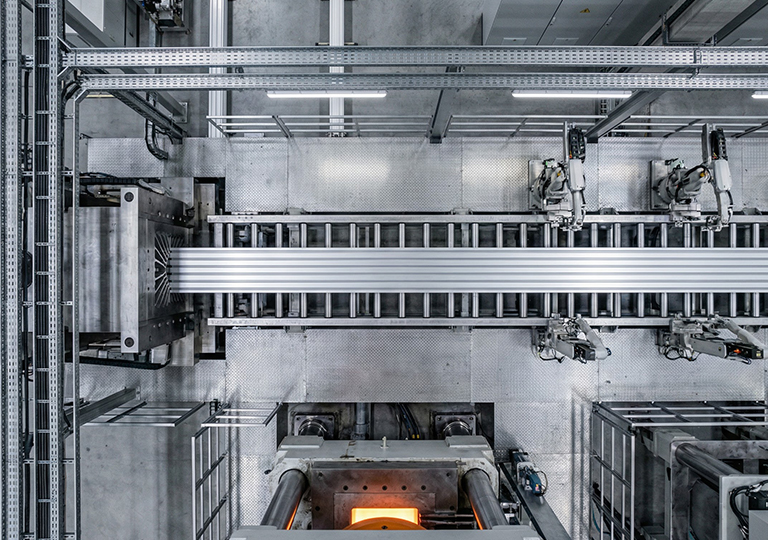
What Defines a High-Capacity Extrusion Press
Higher Tonnage and Structural Rigidity
High-capacity presses are designed to:
- Deliver significantly higher extrusion force
- Maintain alignment under extreme loads
- Handle larger billet diameters
This allows manufacturers to produce:
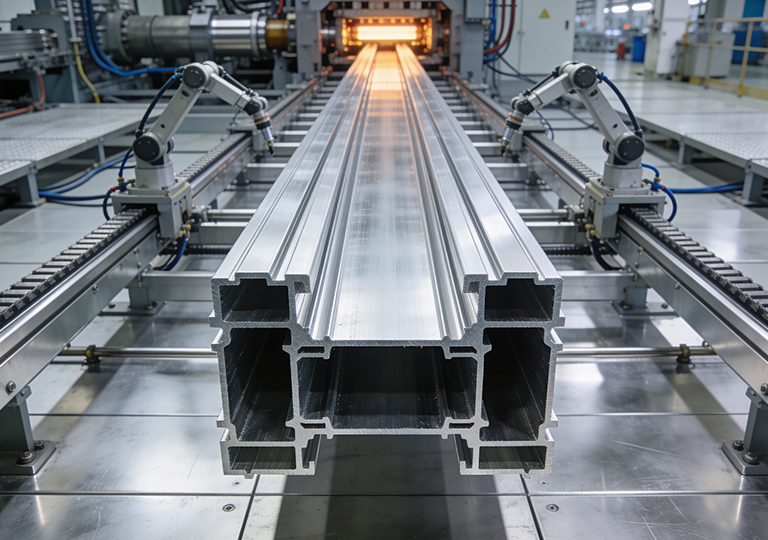
- Wide flat bars
- Heavy structural profiles
- Large hollow sections
Structural rigidity ensures consistent output across long production runs.
Advanced Control Systems
Modern high-capacity presses feature:
- Precise ram speed control
- Accurate pressure monitoring
- Automated billet handling and loading
These systems ensure:
- Stable metal flow
- Reduced surface defects
- Improved dimensional repeatability
Precision control is essential when working at large scales.
Enabling Large and Complex Aluminium Profiles
Wider Profiles with Tighter Tolerances
Large aluminium profiles amplify every minor process deviation.
High-capacity presses enable:
- Uniform pressure distribution
- Balanced metal flow across wide dies
- Better control of wall thickness variation
This results in:
- Consistent tolerances
- Improved straightness
- Superior surface finish
For buyers, this translates into assembly-ready profiles with minimal downstream correction.
Hollow and Multi-Cavity Extrusions at Scale
Producing hollow profiles requires:
- Stable pressure
- Precise die alignment
- Controlled metal flow
High-capacity presses provide the force needed to:
- Maintain mandrel stability
- Prevent weld seam defects
- Ensure internal dimensional accuracy
This is critical for infrastructure, transport, and industrial applications.
Impact on Infrastructure and Construction Projects
Structural Efficiency and Design Freedom
Large aluminium extrusions allow engineers to:
- Replace multiple components with a single profile
- Reduce joints and fasteners
- Improve structural integrity
This leads to:
- Faster installation
- Lower assembly costs
- Improved long-term performance
High-capacity extrusion makes aluminium viable for structural applications previously dominated by steel.
Consistency Across Long Lengths
Infrastructure projects often require:
- Long continuous profiles
- High repeatability across batches
High-capacity presses maintain stability over extended extrusion lengths, reducing:
- Warping
- Dimensional drift
- Rework at site
Supporting Renewable Energy and Mobility Applications
Renewable Energy Structures
Solar and wind installations demand:
- Lightweight yet strong structural members
- Corrosion resistance
- Long lifecycle performance
Large aluminium extrusions provide:
- Reduced structural complexity
- Faster on-site assembly
- Improved load distribution
High-capacity presses enable the production of these profiles reliably and at scale.
Transportation and Heavy Engineering
In railways, logistics systems, and industrial machinery:
- Larger profiles reduce weight
- Integrated designs improve efficiency
High-capacity extrusion supports:
- Crash management systems
- Structural frames
- Equipment housings
This expands aluminium’s role in mobility and heavy engineering.
Tooling and Die Engineering for High-Capacity Extrusion
Die Strength and Design Complexity
Large profiles place extreme stress on dies.
Successful high-capacity extrusion requires:
- Advanced die steel selection
- Optimized bearing lengths
- Precision machining
In-house die manufacturing and rapid correction capability become critical at this scale.
Longer Die Life and Process Stability
High-capacity presses, when paired with proper tooling:
- Reduce uneven wear
- Improve die lifespan
- Enhance process consistency
This reduces downtime and improves delivery reliability.
Quality, Yield, and Cost Efficiency
Lower Scrap Rates at Large Scale
With better control and stability, high-capacity presses:
- Reduce start-up scrap
- Minimize surface defects
- Improve overall yield
For buyers, this improves:
- Cost predictability
- Delivery timelines
- Quality consistency
Economies of Scale Without Quality Loss
High-capacity extrusion allows manufacturers to:
- Scale production volumes
- Maintain tight tolerances
- Meet large project timelines
This balance of scale and precision is a key competitive advantage.
Buyer Expectations in 2026: Press Capacity as a Qualification Criterion
Global buyers increasingly evaluate:
- Maximum press capacity
- Largest achievable profile dimensions
- Experience with large-scale projects
Press capability is now part of:
- Pre-qualification requirements
- Technical evaluations
- Long-term supplier selection
High-capacity presses signal manufacturing maturity and readiness for complex projects.
How Surat Aluminium Aligns with High-Capacity Extrusion Demands
Surat Aluminium focuses on:
- Advanced extrusion press capability
- Precision tooling and die engineering
- Controlled process execution
- Application-driven profile development
This enables the production of:
- Large and wide aluminium profiles
- Complex hollow and structural sections
- Consistent quality for infrastructure, energy, and industrial projects
The emphasis is on engineering reliability at scale, not just tonnage.
Strategic Considerations for Buyers Selecting High-Capacity Extrusion Partners
When evaluating suppliers, buyers should assess:
- Press capacity and stability
- Track record with large profiles
- Tooling and die engineering expertise
- Quality assurance systems
- Ability to deliver consistently at scale
Choosing the right partner reduces project risk and ensures long-term performance.
Conclusion: High-Capacity Extrusion Is Shaping the Future of Aluminium Manufacturing
In 2026, high-capacity extrusion presses are not optional upgrades.
They are enablers of modern aluminium applications.
By unlocking:
- Larger profile dimensions
- Higher structural performance
- Better consistency at scale
High-capacity extrusion is redefining aluminium’s role across industries.
Manufacturers that invest in press capability, tooling expertise, and process discipline will lead the next generation of aluminium manufacturing.